Oyster Mushrooms and Bacterial Botch

This past week, my oyster mushrooms were hit by some sort of bacterial botch, which infected perhaps ~75% of the flushes. It is curious that some of them were infected while others remained clean, but given that most were affected, it is clearly airborne and not specific to a single or few grow bags. The botch seems to have been the most prominent at the in the middle of the caps were there is a slight recess and at the base of the flushes.

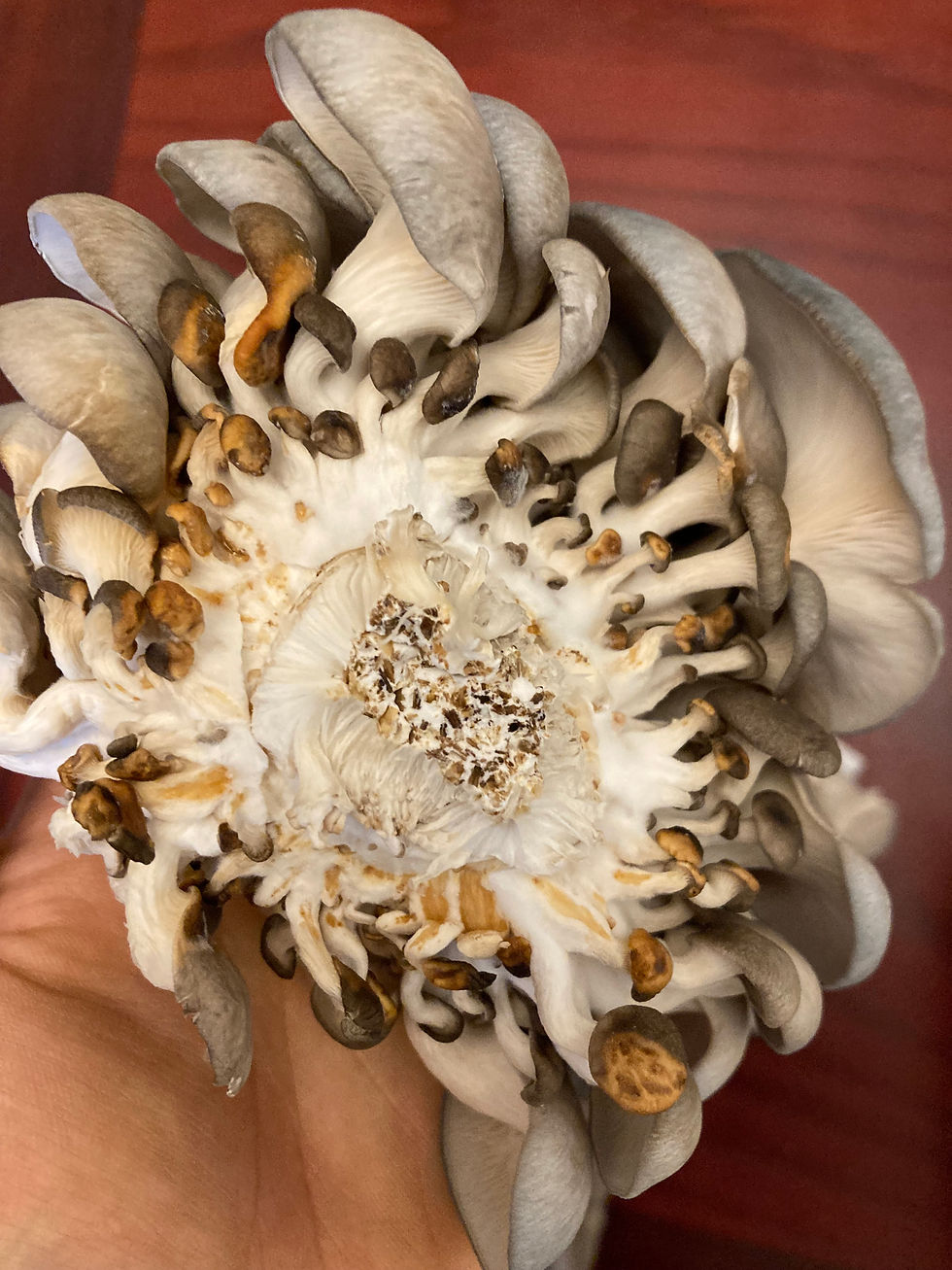
You can kind of see based on these images that the bacterial botch seems to have mainly accumulated in the middle of the caps where the water pools and at the base of the stems where I guess the pinning mushrooms trap humidity more.
Upon conversation with GPT, the problem seems to have been two-fold: (1) A dirty humidifier and (2) improper use of the humidifier. On the first point, it seems to be the case that dirty humidifiers are often the source of bacterial growth. I have encountered this problem before and pledged to clean there more regularly (aiming for twice a week) but grow lazy and fail to incorporate it into my schedule and pay the price. If a humidifier harbors bacteria, it will essentially spray the bacterial mix continuously across all the mushrooms in the grow room, which will obviously result in a large spike in infections. Therefore, ensuring a sterile and clean humidifier is absolutely essential in mushroom farming, and this most recent incident once again forces my attention to this issue.
On the second point, I was not using my humidifier optimally. I had the humidifier pointed at the oyster mushrooms directly, but GPT was saying that the humidifier should always be pointed upward at the ceilings or the walls as most mushrooms hate being misted for continuous periods of time. This does make sense to me based on prior experience. Then relatedly, some experienced growers will not just maintain humidity at 85% - 90% during the fruiting stage, but rather they cycle the humidity down to 70% for 5 – 10 minutes every hour or so. This eliminates a build up of condensation and ensures that bacteria do not have the opportunity to proliferate. So while if the humidifier is squeaky clean, these two things matter less, implementing these controls decreases the likelihood that bacteria can grow.
I also examined other external factors. Realizing I hadn’t checked my incoming air filter in a while, I took a look only to discover how much soot had accumulated. GPT suggested that dusty air was not the main problem, but I’m sure it did not help. Additionally, it caused me to re-examine whether a rectangle was a more optimal shape for grow rooms compared to a square because I had never encountered this problem in a square grow room. My intuition is that the rectangle grow room has better air flow through, which increases rate at which humidity leaves the room and makes constant misting more necessary. With my suboptimal misting set up, I wonder if this could have set the stage for bacterial growth. So the rectangular room is not necessarily better or worse than the square one but exhibits different air flow dynamics.
These incidents make me realize that it’s actually a blessing that I did not expand into a larger facility, attempting to grow hundreds of pounds a week. I just have so many common problems that I have not run into and if I had transitioned to a larger facility sooner, these “small” problems would have been not so small. On a side note, it also illustrates how “business sharks” often underestimate the difficulty of smooth production. Many marketers and sales side people have sold me on the importance of their role, but my response is that you can’t sell something if there’s nothing to sell. I am not understating the importance of sales and marketing but rather illustrate the difficulty of produce that is both high-quality and consistent.
Another blessing is that these “problems” are not actually problems but brain teasers and puzzles to be solved! My mushrooms were hit by a mysterious and ugly orange botch - what is the reason for this??? Although I am aware of the main factors necessary for mushroom growth – air flow, lighting, humidity, cleanliness, etc. – these problems present opportunities to more closely examine each factor and gain a better understanding of the growth system overall. For example, in this incident, I learned about the importance of not only maintaining high humidity throughout the fruiting stage but cycling the humidity between 70 – 90% in order to minimize condensate build up on the caps, which facilitate bacterial growth. Each time I encounter a problem, I see another facet of mushroom growing, and my understanding increases.
Comments