10 Mistakes from Sterilization and Inoculating my First Grain Spawn (v2, revised 12.5.2025)

Updated: Dec 5, 2025
As mentioned in previous articles, I have dragged my feet on the lab work ever since I started this mushroom farming endeavor. One of my first goals was to move the lab work in house, but at every point it just seemed easier to continue to buy commercial grain spawn from other suppliers rather than struggling through the process of making my own and potentially ruining entire batches due to hidden contamination.
However, thanks to the recent realization that I can just buy clean liquid cultures from other cultivators and expand it into more liquid culture and grain, I finally got started with the process of sterilizing grain spawn. I know that there are a couple methods for hydrating grain - you can use the simmering method where you boil it for 10 minutes then let it cool or you can soak the grain overnight and then strain out the water, but I did the simmering for the first time as I was in a time crunch.
After going through the sterilization and inoculation process, I realized that I had made a large number of mistakes throughout the process - as further expounded upon in conversations with GPT/Grok. Therefore, I wanted to list ten mistakes I made from doing my first batch of grain spawn.
Mistake 1 - Not checking the hydration ratio
For the purpose of hydrating the grain, I had used the simmering technique to boil and then let the rye grain absorb water. However, I did not compare the total weight to the dry weight and ensure that there was ~ 50% water weight in total (per Stamets in Growing Gourmet and Medicinal Mushrooms; note that the ratio of water used will decrease to as low as 38% as the size of the grain vessel increases - e.g. a gallon). Keep in mind that dry rye usually comes at a hydration ratio of about ~10%. So, if the starting weight of the dry rye was, say, 11 lbs (~10 lbs dry and ~1lb wet), then the ideal total weight would be 20 lbs. If after hydration, it was far off, then the hydration method might need to be reconsidered.
Also keep in mind that different grains have different hydration recommendations. Rye is closer to ~60% water (of total weight) while millet absorbs less water and is closer to ~40%.
For this reason, the overnight soaking method is often recommended for beginners. They can simply fill the 1 quartz jar with the appropriate amount of grain and water and let it hydrate overnight - this ensures that they achieve the desired hydration ratio exactly.
Mistake 2 - Not sealing the vessel before sterilization
The beauty of the liquid culture injections is in that the risk of contamination propagating is near zero if done correctly. This requires the vessel holding the grain to be completely sealed pre-sterilization, then it can just be injected in front of a laminar flowhood using the injection port with minimal risk.
Regarding 1 quartz jars (and similar vessels)
For the 1 quartz glass jars, each lid should be fitted with a tightly fit silicon injection port and small 1/4 - 3/8 inch filter patch hole for air exchange and then the lid should be tightly screwed on pre-sterilization. The liquid culture can then be injected through the silicon injection port post sterilizationd
Regarding Unicorn bags
To minimize risk, these should be heat sealed before sterilization with a small amount of air inside. This ensures that it does not need to be opened or sealed afterwards and mitigates the risk of contamination. Yes, if doing agar inoculations, then one would not heat seal until after the sterilization, but the beauty of the liquid culture technique is in that one can seal the bag earlier and then just inject the liquid culture through the silicon injection port that should be attached beforehand.
Mistake 3 - Under- or over- sterilizing
In Michael Crowe's book, A Journey into Mycology, he states that he always sterilizes his 6 lb bags for four hours (see image below) in order to ensure they are completely sterile. Therefore, I thought it made sense to sterilize my hydrated rye grain for four hours as well, and I sterilized my first batch for four hours at 15 PSI.

This conflicts with Gary's information which says he only pressure cooks the 5-lb grain bags for an hour (see image below).
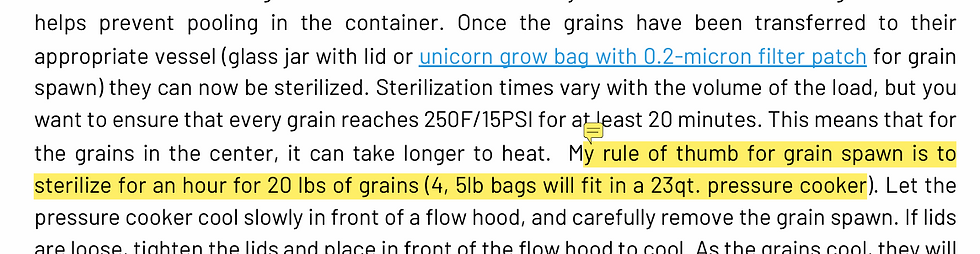
So what would explain the difference?
First, neither specify the type of grain they are working on but based on context, Gary is likely working with rye or oats whereas Michael Crowe is working with millet. Millet not only soaks up less water (explaining Michael's ~40% hydration ratio vs 60% recommended by Gary), but has a smaller grain size, meaning there is more surface area for contamination to hide - also maybe the smaller size packs kernels more tightly together, making steam penetration harder. I also believe that Gary is being optimistic with his 1-hour sterilization recommendation whereas Crowe is being very conservative. Therefore, it might be wise to bump up Gary's time to ~ 2 hours and adjust Crowe's method down to ~3 hours (considering using rye not millet), so 2.5 hours seems to be a good compromise and then I can adjust upward or downward.
Crowe does acknowledge that ~3.5 hours with millet is usually good enough, so maybe it can be extrapolated that 2.5 hours with rye is also fine.

In conclusion, 60 minutes to 90 minutes is likely adequate for 1 quartz jars where as 2 hours is likely minimum for 3 lb bags (and increase time with increase in amount of grain sterilized in one vessel). So for a 5 lb bag, 3 hours is likely adequate. 4 hours seems like overkill unless you are working with millet.
Under sterilization will result in bacterial contaminations, which will be a sign that sterilization times need to increase.
Mistake 4 - Improper liquid culture injection technique
The liquid culture syringe should be taken out of the refrigerator at least a few hours before injection.
The liquid culture syringe should be shaken vigorously to evenly distribute mycelium within syringe before injection (otherwise might inject mostly water into one bag and mostly mycelium into another if using for two bags, or it might stick to one side of syringe and not release completely).
For 1 quartz jars, people typically recommend, tilting the jar at a 35 - 45 degree angle and letting the LC run down the side of the jar so they can watch the colonization process happen.
Mistake 5 - Improper liquid culture injection amount
The typical amount of LC recommended for each 1 quartz jar or less is typically around 3 - 5 ml. More experienced cultivators will be able to get away with the lower end while less experienced ones should stick to 5 ml for maximum chance of success.
That being said, more liquid culture does not higher chance of success. For 1 quarts jars, there is no marginal benefit of injecting it with more than 5 ml. In fact, injecting it with more than 5ml can create overly wet conditions (as liquid cultures are mostly water), so it is in fact, counterproductive.
Regarding larger vessels like 5 lb grain bags, the AI was saying around 10 ml is appropriate but not more for similar reasons as above. However, I've noticed that the AI has been so wrong about liquid culture and grain spawn inoculation related questions that I'm not completely certain what the best answer is here. I will continually revise this article as I hone my understanding with real world experience.
Mistake 6 - Wrong temperature for colonization
Ensure that the temperature for colonization is around ~70 F. As its winter right now, my basement is a bit colder, at around 65 F. This does not prevent colonization of the inoculated grain spawn, however it does slow growth. Given that I am a beginner seeking to maximize my chance of success, letting the grain colonize at closer to 70F would probably bring a higher chance of success
Mistake 7 - Not using the right grain or not adding gypsum
While mycelium is pretty robust and can on almost any grain, for beginners, choosing the right grain and making sure that its organic can ensure higher chances of success. One of the most beginner friendly mediums is rye as it is the most common grain spawn medium and much of the advice around grain spawn is tailored towards it. Additionally, getting organic grain ensures that its free from anti-fungal pesticides which could possibly inhibit mycelial growth.
Gypsum is also recommended to be added at 1 - 2% of total weight. And it supposedly helps with providing mycelium with trace minerals while also preventing grain spawn from clumping.
These two things are not 100% critical as experienced growers could probably get by using any grain and not using gypsum. However, it makes sense to go with the safest and reliable route for beginners until they can get the hang of it.
Mistake 8, 9, and 10 - To be discovered...
Conclusions
First conclusion
It's only been one day since I injected the grain spawn with the liquid cultures so I can't yet detect any mycelial growth - we will see whether or not the grain is successfully colonized despite all the above mistakes. Either way, I am very happy with the fact that I finally started grain sterilization and now I can reflect on what I've been doing and iterate continuously. My hope is that I'm successfully doing full cycle lab work (minus breeding) within the next few months and then I can jump into mushroom breeding projects, which should be much more interesting.
Revised conclusion (as of 12.5.2025)
In my second attempt at grain spawn, I used the simmer technique again and not the soaking one and forget to measure the water ratio exactly, so I'm not sure what the hydration ratio was. I did add gypsum and I think will continue to do that as it should incrementally help for beginners like myself.
I noticed small orange pockets of bacteria in my grain spawn which is a classic sign of understerilization (I had to leave the house and needed to turn off my sterilizer, so total sterilization time was close to only 30 - 40 minutes). I guess this is why at least an hour is recommended but probably closer to 90 minutes is better to be honest.
I think my new approach for my next batch will be as follows: 1 quartz jars > unicorn bags for beginners --> cold soaking overnight with exact hydration ratio --> sterilization for 90 minutes --> inject 3 - 5 ml of liquid culture into each jar tilted at 35 - 45 degree angle to let it run over the side --> make sure to store jars at around 70F. I think if I do this, it'll fix my problems.
Comments